From beauty parlor to strategic partner
In the early days of our UX team’s formation, we faced a common challenge: we were primarily seen as a “beauty parlor” expected to make screens and interfaces attractive. Usability research and user needs exploration were novelties, largely misunderstood by the broader organization. Designing user flows based on customer understanding created tensions between designers, developers, and business representatives.
Project timelines were established long before design requests reached us, making scheduling proper user research, usability testing, and design iterations challenging. Even when product teams understood the value of a customer-centric approach, integrating it into established workflows remained challenging.
A communication challenge
We needed a way to educate our peers and stakeholders about our work from multiple angles:
- What series of actions are required to deliver world-class customer experiences
- What outcomes does each step produce
- How much time, effort, and skill do these activities demand
While we initially relied on the Double Diamond framework1 to explain our approach, we found it too abstract for practical project planning. This insight prompted a change in our communication strategy, with process mapping becoming a key component.
Our approach to process mapping
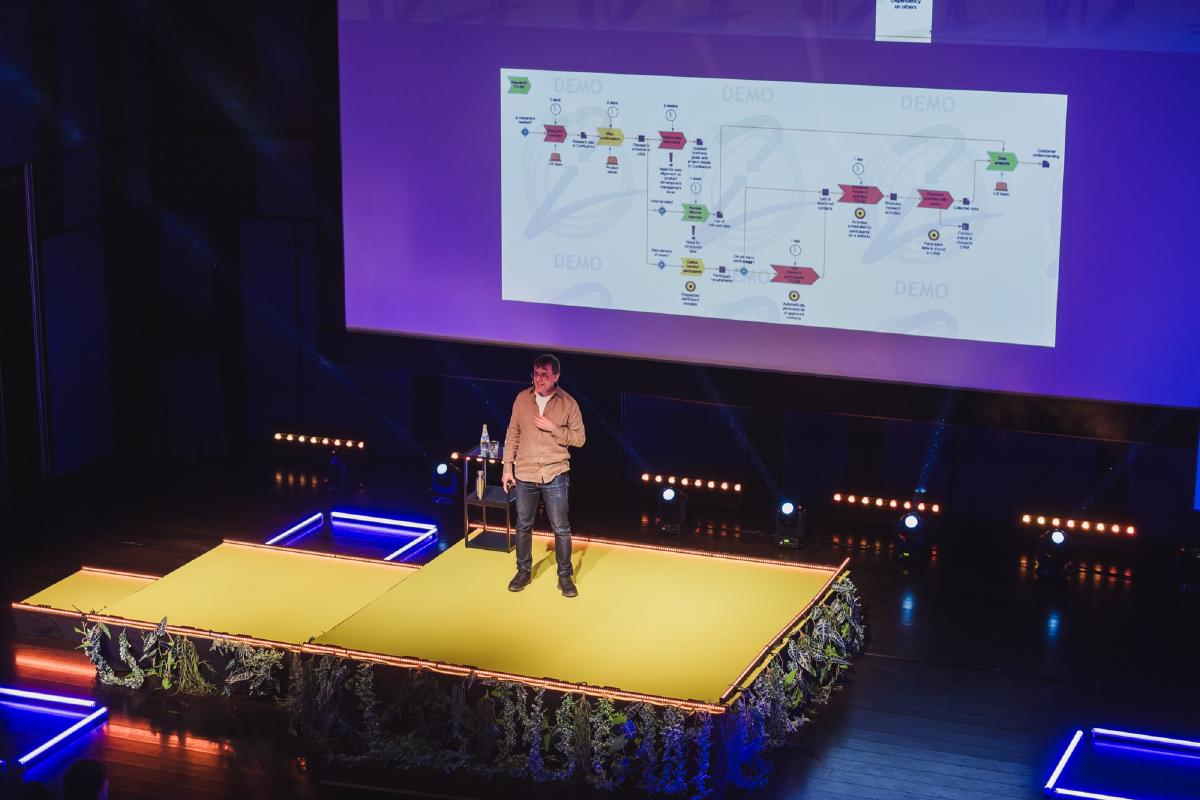
I used 2c82 to model our UX team’s value creation within the corporation. This tool offered several powerful benefits:
- Outcome visibility: Each activity required a specific output or artifact, making it easy to evaluate and communicate the value of each step.
- Value assessment: Activities were evaluated based on lean methodology from a customer value perspective:
- Green for clearly valuable activities
- Yellow for mandatory activities
- Red for non-valuable but necessary actions
- Role clarification: Using the RACI model (Responsible, Accountable, Consulted, Informed) for each step helped clarify ownership and identify delegation opportunities.[^RACI]
- Improvement tracking: The tool allowed us to note target improvements and focus areas for future optimization.
- Visual workflow: The process was presented in an easy-to-read visual format.
I started by using the Double Diamond framework to express our team’s scope of work, then created detailed maps of current design and research activities. Rather than focusing on precision for specific projects, I aimed for a generalized illustration that could be adapted to various scenarios.
The final step involved analyzing each activity for improvement opportunities, creating “to-be” maps with improvement targets and measurements. This became the foundation for our strategic project backlog.
From mapping to real-world benefits
The process model changed how we worked in practice:
Project planning and flexibility
By mapping key sequences and dependencies, we could assemble project plans like Lego pieces, combining activities based on specific project needs. This gave us a clear understanding of time requirements, effort needs, and dependencies.
This level of planning enabled us to see and orchestrate the whole product design sequence, making informed adjustments when necessary. For example, when faced with an urgent request while managing a year-long project, we could intelligently pause the original project at a strategic point, complete the urgent work, and resume the initial project – all without sacrificing quality or team wellbeing.
Waste elimination through role optimization
Our mapping revealed opportunities to delegate and redistribute responsibilities. For instance, stakeholder interviews – crucial for understanding project requirements and aligning expectations – were initially conducted by UX team members.
Through our process evaluation, we realized these interviews should be conducted by product owners who are ultimately responsible for product delivery and business value. By transferring this responsibility, we saved approximately two weeks of project setup time while ensuring the information was captured by those who needed it most.
Design system implementation
One of our most successful improvements came from focusing on design system implementation. This enabled UX designers to create nearly production-ready high-fidelity prototypes without depending on UI designers’ time. The UI designers could then focus on design system development and maintenance. This change virtually eliminated delays in final design deliveries, directly reducing time-to-market and addressing multiple forms of waste3:
- Defects: Reducing failures to meet customer expectations
- Waiting: Eliminating time spent waiting for the next process step
- Motion: Reducing unnecessary movements by people
- Transportation: Minimizing unnecessary handoffs of designs
- Unused talent: Better utilizing people’s talents and skills
Design leadership insights in your inbox
Bi-weekly from my practice. Quarterly exclusives from my practice.
Connecting to Lean principles
Toyota’s lean product development methodology deeply informed our process mapping exercise, focusing on eliminating waste and streamlining workflow.
Shortening feedback loops: Enabling UX designers to create production-ready interfaces and prototypes allowed them to experiment and learn directly from users, which eliminated back-and-forth communication, reduced motion and waiting time, and minimized design defects.
Eliminating non-value activities: We could delegate or automate these tasks by identifying activities like research participant recruitment that consume valuable designer time without adding proportional value.
“Going to the Gemba”4: Integrating UX designers into product teams allowed them to be closer to where value is created, improving their approaches, and owning the final results of their efforts.
Practical implementation
Start simple
The process mapping exercise is valuable because it systematically and sequentially expresses what your team is doing. Focus initially on documenting current practices rather than designing the ideal state.
Focus on outcomes
For each activity, clearly define the outcome or artifact produced. This helps express the purpose and value of each step in the process.
Tools are secondary
While 2c8 was valuable for our process mapping, it’s also costly and potentially overkill for many design teams. Once you understand the principles, you can apply them using various whiteboard applications or on paper.
Identify opportunities
For each activity, consider:
- Elimination: Can this step be removed entirely?
- Delegation: Can this responsibility be transferred to someone else?
- Automation: Can this process be systematized or automated?
Communicate strategically
While detailed process models may be too complex for broad organizational understanding, they remain powerful tools for UX leadership to track and inform process optimization efforts. When communicating with stakeholders, use simplified versions.
Process mapping gave our UX team a way to show what we did, where the waste was, and what to change. We reduced project timelines, clarified responsibilities, and gained the flexibility to adapt when priorities shifted.
The first step is mapping just one process. Focus on the outcomes of each step and who is responsible. The answers lead to the next question: how do you measure what the team produces.
“The Double Diamond,” Design Council. ↩︎
“Map Your Business,” 2c8. ↩︎
Nawras Skhmot, “The 8 Wastes of Lean,” The Lean Way. ↩︎
John Shook, “How to Go to the Gemba: Go See, Ask Why, Show Respect,” Lean Enterprise Institute. ↩︎